Role
Sketch and 3D surface modelling
Course
IDUS 231, SCAD
Date
Dec 2025
Tools
Rhino
01
Brief
A luxury motor yacht for IDUS 231 at SCAD, December 2025. I started from my own marker line sketch: fine bow, flat hardtop, U-shaped seating at the stern. The sketch fixed the silhouette. The open question for Rhino was how hull and deck meet without a visible break.
02
Process: Rhino surfacing
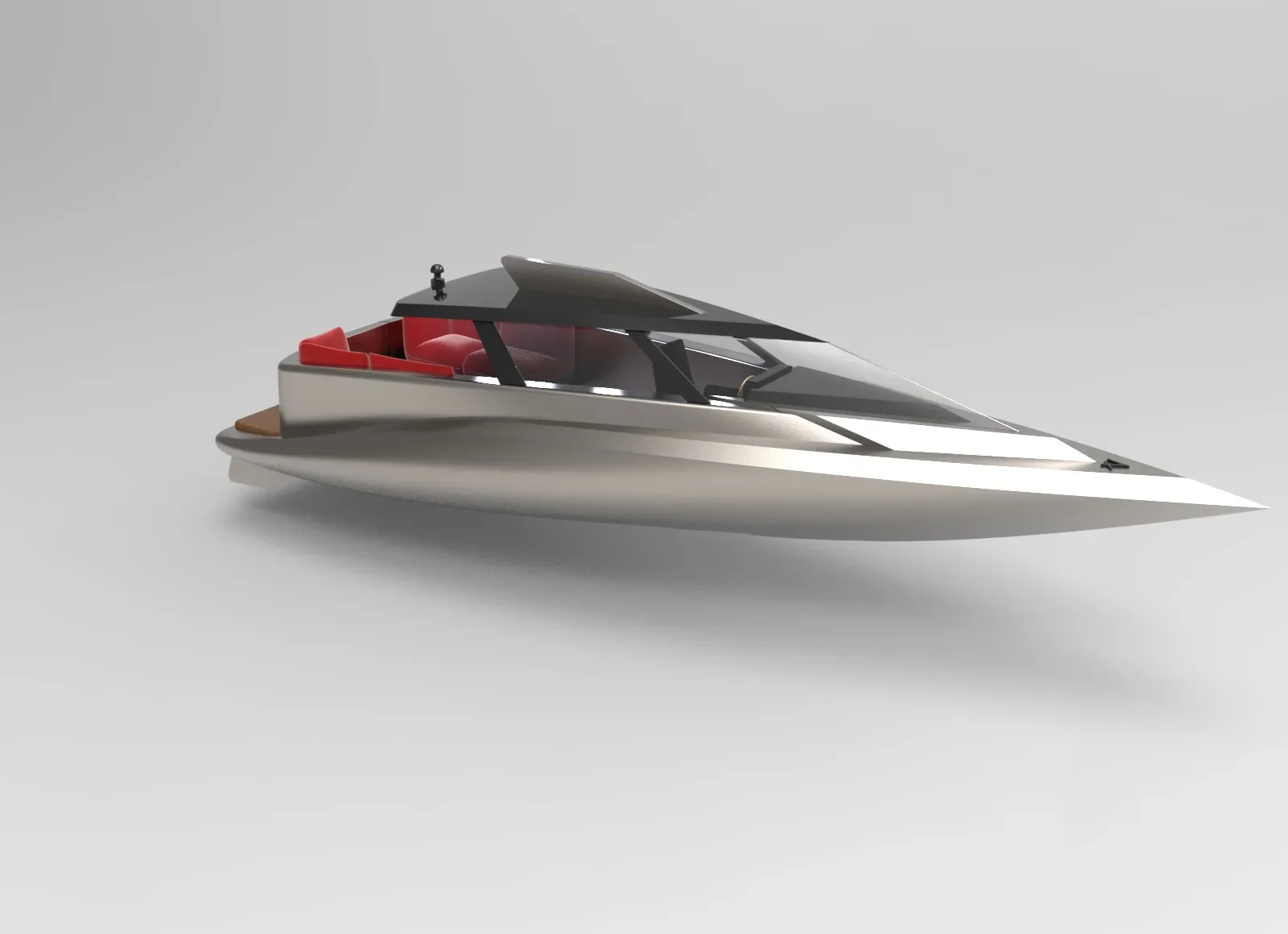
I set up four viewports (top, perspective, front, right) with the proportions at 1:35 to work more easily in Rhino. Hull and deck are modelled as one continuous metallic surface, not a deck placed on a hull. The isocurve view shows how the surfaces flow into each other. Seats and helm chair sit inside the model, so the wireframe shows the cockpit layout too.
03
Renders
Every render comes from the Rhino model. Most use a clean studio backdrop to show side, aerial, stern and top views: a V monogram hatch and a teak-look swim platform at the stern. Inside, the helm has a wooden wheel and the lounge has tan leather seats.
Helm and lounge renders are composited over a photo backdrop.
04
In motion
Four short clips, animated with Google Veo from my renders: a sunset cruise, the boat planing past a cove, an aerial of the stern and a top-down pull-back. The movement is AI-generated, so it shows mood and speed, not engineering. The model and renders are mine.
Animated with Google Veo from my renders. AI-generated; small Veo watermark, no sound.
05
3D model
This is the Rhino model itself, converted to glTF. Orbit it, zoom in and check how hull and deck meet.
Loading 3D model…
Drag to orbit · Scroll or pinch to zoom · Reset view
Your browser can't run the 3D viewer, because WebGL is off or unsupported. The renders above show the same model.
06
What this shows
CAD surfacing: building a large, smooth, single-skin form in Rhino and keeping it coherent across all four views at once. It is a surface-modelling project, with no drawing sheets or assembly study. Those are in the faucet and technical drawing projects. The animations are AI-made from my renders and are not part of the design work.